
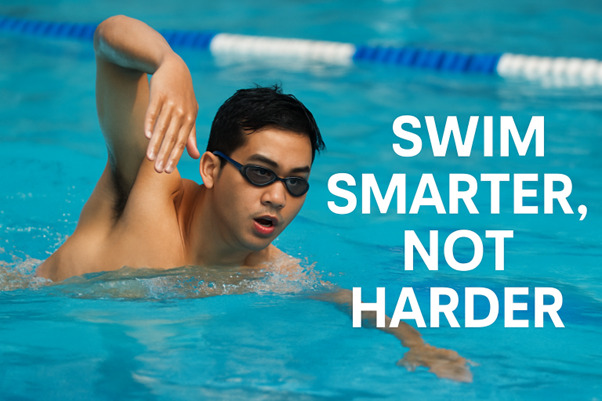
Swim Smarter, Not Harder: Efficiency Techniques Every Swimmer Should Know
Swimming is one of the most technical sports in the world. Whether you’re a beginner learning your first strokes or an experienced athlete trying to shave seconds off your lap time, the key to consistent improvement isn’t always about working harder—it’s about swimming smarter.
In this article, we’ll break down the most effective, science-based efficiency techniques every swimmer should know. These strategies will help you glide through the water with less effort, reduce fatigue, and see long-term progress in your training and performance.
Let’s dive right in.
Set Clear, Measurable Goals
Every smart training plan starts with a clear goal.
Setting SMART goals (Specific, Measurable, Ambitious, Relevant, and Time-bound) provides the structure you need to stay focused and progress steadily. Without a roadmap, swimmers often plateau because they train aimlessly, swimming laps without purpose.
For instance, instead of saying, “I want to swim faster,” a SMART goal would be, “I want to reduce my 100m freestyle time by 3 seconds in 8 weeks.” This approach gives you direction and motivation, ensuring every session serves a purpose.
Tracking progress against these goals also helps you adjust your training when needed. If you’re not seeing the expected improvements, you can reassess your drills, technique, or even recovery routines to get back on track.
Streamline to Reduce Resistance
Water is 784 times denser than air. That means even the smallest inefficiencies in your body position will slow you down significantly.
Streamlining is one of the most crucial skills for efficient swimming. A tight, well-aligned streamline reduces drag and helps you maintain momentum, especially off walls and starts.
To streamline properly, extend your arms above your head with one hand on top of the other, squeeze your biceps to your ears, and engage your core. Your head should be in a neutral position, looking down—not forward. This helps keep your hips high and body horizontal in the water.
Practising streamline glides during warm-ups and push-offs conditions your body to maintain optimal posture throughout the swim.
Improve Stroke Mechanics
Smart swimmers know that technique always beats brute force.
One of the most important aspects of your stroke is the catch—the phase where your hand first enters and grabs the water. A proper catch sets the foundation for effective propulsion. Bend your elbow early, keep your fingertips pointing down, and push the water behind you using your forearm and hand as one unit.
Avoid crossing your arms over the centre line of your body during the freestyle stroke. This common error leads to imbalance, poor alignment, and unnecessary drag. Keep your hands entering the water in line with your shoulders for a more powerful, efficient stroke.
Focusing on small details like elbow position, hand path, and body rotation can make a big difference in how far you move with each stroke.
Refine Breathing Technique
Breathing might seem simple, but poor technique is one of the biggest culprits of inefficiency.
Bilateral breathing—alternating sides every three strokes—not only improves body balance but also develops symmetrical muscle use. Swimmers who only breathe on one side often suffer from imbalances that affect posture and propulsion.
Equally important is learning to exhale underwater. Holding your breath builds up carbon dioxide and increases the urge to breathe prematurely. Instead, maintain a steady exhale through your nose or mouth while your face is submerged, and inhale quickly when you turn to breathe.
Proper breathing rhythm reduces panic, increases endurance, and allows you to focus on your stroke instead of your lungs.
Kick with Purpose
Kicking can account for up to 10–15% of your propulsion in freestyle, but it often wastes more energy than it generates—especially when done incorrectly.
The key is to kick from your hips, not your knees. Many swimmers bend their knees too much, causing turbulence and slowing down forward movement. Instead, think of your legs as extensions of your torso, generating small, quick movements from the hip joint with pointed toes and relaxed ankles.
Incorporate vertical kicking drills and kickboard sets into your training to build ankle flexibility and leg strength. Keep your kicks narrow and continuous, especially during sprints and starts.
A consistent and efficient kick supports body position and complements your stroke.
Use Technique-Focused Drills
Drills aren’t just for beginners. They are powerful tools that help isolate and improve specific components of your stroke.
For example, the catch-up drill improves hand timing and balance, while sculling drills enhance your feel for the water. For more advanced swimmers, fingertip drag drills promote high elbow recovery and better hand entry.
Always perform drills with intention. Rushing through them without understanding their purpose won’t yield results. Quality is far more important than quantity.
Integrate 10–15 minutes of targeted drill work into each session to reinforce technique improvements consistently.
Apply Tech and Tools Strategically
Smart swimmers make use of the right tools—not to shortcut their progress, but to refine it.
Fins help improve ankle flexibility and develop leg strength. Snorkels allow you to focus on stroke mechanics without worrying about breathing. Paddles increase resistance to strengthen your pull and expose flaws in your catch.
More importantly, wearable swim technology now allows swimmers to track stroke rate, heart rate, distance, and pace in real time. Even without such gadgets, simple tools like tempo trainers and pace clocks can help maintain consistent speed and rhythm.
Use equipment selectively and always with a clear purpose. They should support, not replace, technical development.
Prioritise Recovery
Swimming smarter also means knowing when not to train.
Overtraining is a real risk, especially in high-volume programmes. Fatigue reduces coordination, increases the chance of injury, and stalls progress. Make time for active recovery sessions—light swims, stretching, or dryland mobility work—to help the body repair and adapt.
Hydration, sleep, and proper nutrition are equally important. Your muscles recover and grow outside the pool, not in it. A well-rested swimmer always performs better than an overtrained one.
Consistency in training must be balanced with adequate recovery to sustain long-term gains.
Conclusion
Swimming smarter is about taking control of your training with purpose, awareness, and efficiency.
Every lap should have intention. Every drill should target improvement. And every breath, kick, and stroke should bring you closer to mastering the water.
Whether you’re chasing a personal best or just trying to feel more at ease in the pool, remember—it’s not about how hard you work, it’s about how well you move.
FAQs
How can I swim faster without using more energy?
The key is improving technique. Focus on body alignment, an efficient catch, and streamlined kicking. Reducing drag and increasing stroke efficiency allows you to go faster without burning more energy.
Should I train with paddles and fins all the time?
No. These tools are best used to focus on specific areas like strength or ankle flexibility. Overuse can lead to poor technique habits or even injury. Use them purposefully and sparingly.
How often should I practise swimming drills?
At least 10–15 minutes per session. Drills reinforce proper movement patterns and help correct technique flaws. Even elite swimmers incorporate them regularly to stay sharp.